
By Kyoko Yamafuji and Madeleine Woods
“The benefits human populations derive, directly or indirectly, from ecosystem functions”. Constanza et al. (1997).
“The capacity of natural processes and components to provide goods and services that satisfy human needs, directly or indirectly”. de Groot et al., (2002).
“Components of nature, directly enjoyed, consumed, or used to yield human well-being” . Boyd and Banzhaf (2007).
These are just some of the attempts made to define the phrase “ecosystem services”. Despite the variations in terminologies and detail, most definitions can be simplified/reduced to the definition given by the Millenium Ecosystem Assessment, summarising the ecosystem services simply as “the benefits people obtain from ecosystems” (2005).
This is in line with the origin of the concept, which first emerged in the late 1970s as a way of engaging the wider public in discussions around nature, by framing the functions of ecosystems as services to people and to encourage more environmentally friendly behaviours.
The modern ecosystem services have been divided into four broad categories, consisting of:
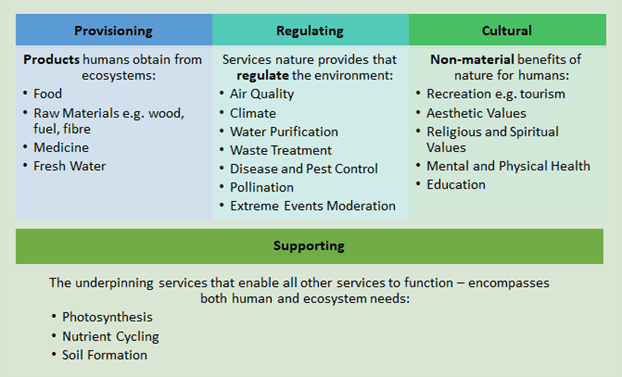
Figure 1: The four branches of ecosystem services and examples of roles each play in people’s livelihoods. Provisioning, regulating and cultural services tend to be direct and short-term in their impacts, while supporting services indirectly impact people over a long duration of time (MEA, 2005).
According to the World Economic Forum, the global estimated annual worth of ecosystem services in 2010 was a whopping $125 trillion – such statistics obtained by putting tangible value on nature is helpful in communicating the importance of ecosystems to the wider public, policy-makers and businesses that make nature-impacting decisions on a daily basis.
Despite their intrinsic value, both economically and culturally, ecosystems are under stress worldwide – from the Kelp forests of the Pacific to the Arctic tundra, ecosystems are being altered, threatened, and, in the worst cases, lost. The IPBES’ 2019 Global Assessment report on biodiversity and ecosystem services concluded that 75% of the Earth’s land surface had been significantly altered, 85% of the world’s wetlands have been lost and that around 1 million species are facing extinction within the next few decades.
The main threats facing ecosystems are for the most part a result of human actions:
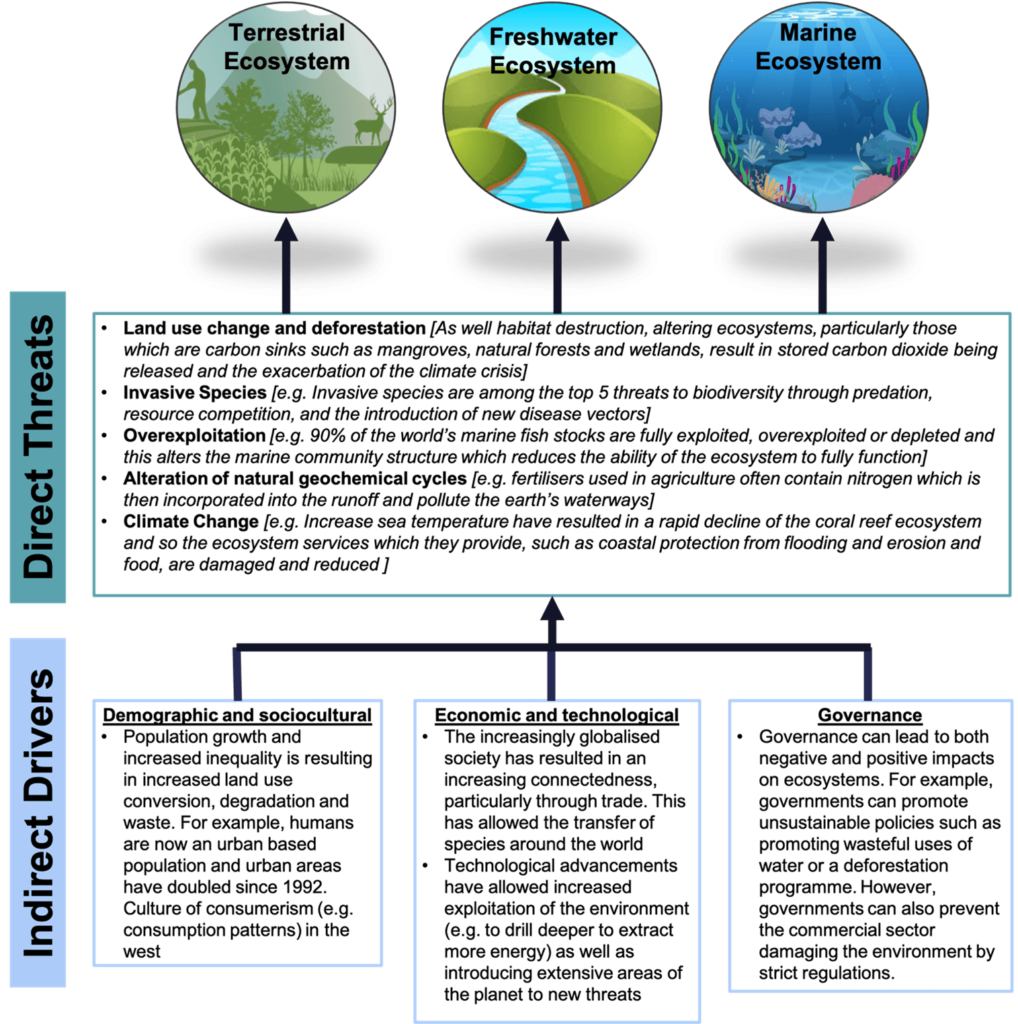
Figure 2: A conceptualisation of the main threats which damage ecosystem services. It is important to note that these threats are a result of the nature of human society, such as the consumerist culture, poor global governance and increased trade.
As already said, it is important to quantify the value of an ecosystem as it makes it easier to convey their importance to governments, businesses and the wider public – if there is one thing humans understand it is money. However, there are two main challenges which come with trying to quantify their monetary value. Firstly, the value of some services, such as the biodiversity whose value is dependent on their existance and not anything tangible (e.g. Blue whale), are hard/near impossible to quantify. Secondly, ecosystem services work across different temporal scales. For example, birds and bees pollinate crops on a sub-annual timescale but carbon sequestration is a process which occurs over millennia. Multiple methodologies have been suggested to overcome these problems including:
Biophysical assessments are considered the most effective/accurate at quantifying the value of ecosystem services but they are expensive, small scale and time consuming.
Ecosystem services have become buzz words in the last two or three decades and has been embedded into national (e.g. UK National Ecosystem Assessment) and international (e.g. Intergovernmental Platform on Biodiversity and Ecosystem Services and the Common International Classification on Ecosystem Services) environmental policy initiatives. It is argued that framing ecosystems in terms of their benefits to society may be the most powerful way to convey the environmental crisis and incite a shift towards better environmental management. The value of the “Ecosystem Services” concept will be discussed and critiqued in next week’s blog post.