
Download Ocean Bottle Case Study
Ocean Bottle exists to bring people together to turn the tide on ocean plastic. Ocean Bottle makes reusables work even harder for the planet, through design-led products that fund the collection of ocean-bound plastic with every sale and refill. Ocean Bottle partners with organisations in areas where plastic pollution is worst, opening plastic collection points where collectors can exchange plastic for money and access social resources such as healthcare, education, mental health support, and financial security. Ocean Bottle’s goal is to prevent 7 billion plastic bottles from entering the ocean by 2025.
Client Objectives
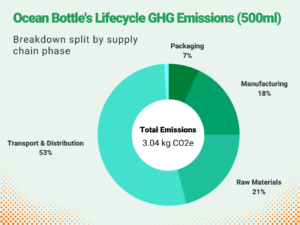
When Ocean Bottle came to us, they wanted to calculate a Life Cycle Analysis (LCA) of their core products, primarily the 500ml Ocean Bottle. The life cycle analysis aims to calculate the total Greenhouse Gas (GHG) emissions emitted by one Ocean Bottle over its entire lifetime, from the extraction of raw materials to the end of its life and ultimate disposal.
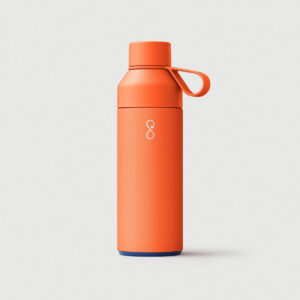
Ocean Bottle already had good visibility throughout its supply chain and could provide a clear picture of an Ocean Bottle’s life cycle.
The ability to assign an environmental impact to each stage in the Ocean Bottle’s life enabled Ocean Bottle to pinpoint high-impact activities as a priority for GHG emissions reduction. Additionally, we provided detailed recommendations about how Ocean Bottle could reduce its impact throughout the supply chain.
Business Challenges
Ocean Bottle already had a good knowledge of their supply chain when they came to us. However, some products were not in production yet, meaning that there were challenges associated with making the most accurate assumptions to assign GHG emissions. That being said, this was easily tackled with our advice and experience with life cycle analyses.
Additionally, Ocean Bottle’s increasingly global consumer base meant that the final products were delivered using a wide range of freighting methods and routings. This complicated the supply chain, and as a result, the lifecycle analysis, because the carbon intensity of product distribution is heavily influenced by the mode of transport and the distance over which they are transported.
Green Element ensured that these deviations were accurately accounted for when calculating the lifecycle emissions by mapping out five separate distribution routes: UK, Ireland, Europe, USA, and Rest of the World.